
Across financial services, healthcare, and enterprise environments, expectations around AI risk management, oversight, and accountability are no longer optional. Beyond written policies, they now extend to oversight, training, vendor risk, and ongoing monitoring across tools like Claude, ChatGPT, Copilot, and embedded AI in your SaaS environments.
BW Cyber is excited to introduce our AI Risks and Governance Services, designed to help organizations adopt AI responsibly and securely, while building scalable, defensible governance.
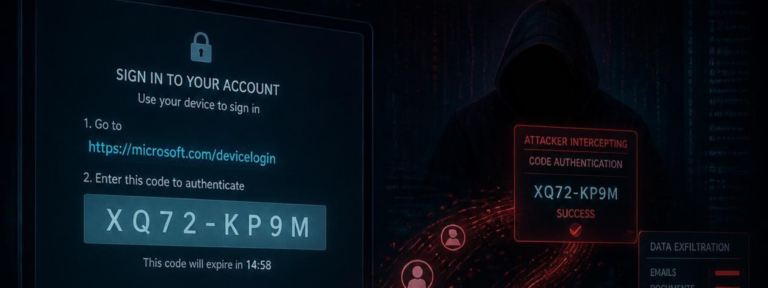
A new wave of phishing attacks is bypassing MFA without stealing a single password. The technique is called “device code phishing”, and it doesn’t rely on a fake login page or a stolen credential. Instead, it tricks users into authorizing an attacker’s session on Microsoft’s own real login page. Microsoft’s security research team recently detailed a large-scale campaign using this technique, and similarly, researchers at Abnormal AI have tracked a related toolkit called EvilTokens that automates the entire attack end to end.
This isn’t a theoretical threat. It’s active right now, and it’s built specifically to slip past MFA.

A new AI attack has exposed terabytes of credentials belonging to more than 2,500 organizations, including Cisco, Samsung, AWS, Airbus U.S. Space & Defense, and the London Stock Exchange Group. The target was LiteLLM, a widely used open-source gateway that connects AI development tools to over 100 large language models. As Ars Technica reported, some of those credentials are still valid nearly five months after the original breach.
This is exactly the kind of quiet, high-impact incident that can sit undetected inside a firm’s environment for months while attackers hold the keys.
We hope you found this month’s BW Cyber newsletter helpful. If you’d like to discuss any of these topics or explore ways to strengthen your firm’s cybersecurity, contact us at info@bwcyberservices.com.
